
Understanding the small-cap nuclear landscape in 2026

This month I have decided to shift focus to nuclear stocks. Mostly, this is because energy consumption/ requirement has skyrocketed in recent years, and nuclear seems to be the only way to produce such large amounts at scale.
As such, the policy environment around nuclear power has shifted substantially in 2025. President Trump signed four executive orders on nuclear energy in May 2025, targeting an increase in US nuclear capacity from 100 gigawatts today to 400 gigawatts by 2050. At the same time, the Department of Energy (DOE) launched the Reactor Pilot Program in June 2025, selecting 11 advanced reactor companies to work toward achieving criticality by July 4, 2026, using DOE authorization directly, as opposed to the conventional Nuclear Regulatory Commission licensing process.
In January 2026, the DOE announced $2.7 billion in contracts to strengthen domestic uranium enrichment capacity over the next decade. This followed the addition of uranium to the US Geological Survey’s List of Critical Minerals in late 2025, signaling government concern about supply chain dependence on foreign producers.
The numbers
The economics around nuclear power purchase agreements has rapidly changed when hyperscalers started securing dedicated capacity. Microsoft signed its Three Mile Island deal in September 2024. Amazon secured a 1.92-gigawatt agreement with Talen Energy for the Susquehanna nuclear plant in June 2025. Meta signed a 1.1-gigawatt deal with Constellation Energy for the Clinton, Illinois plant in June 2025, and in January 2026 announced a 6.6-gigawatt nuclear procurement strategy. Google’s agreements include both the Duane Arnold restart and a small modular reactor deployment with Kairos Power targeting the 2030s.
Data center electricity demand in the US is projected to climb from 19 gigawatts in 2023 to 35 gigawatts by 2030, according to the Federal Energy Regulatory Commission. McKinsey estimates that global AI-powered data center infrastructure capital expenditure will reach around $7 trillion by 2030. The International Energy Agency projects that data centers, artificial intelligence, and cryptocurrencies together could consume over 1,000 terawatt-hours annually by 2030, roughly equivalent to Japan’s total electricity consumption.
This demand is hitting a grid already facing capacity constraints. Northern Virginia, the world’s largest data center market, has 5.9 gigawatts of data centers operating, 1.8 gigawatts under construction, and 15.4 gigawatts of planned projects. Data centers already account for 25% of Virginia’s electricity demand. Nuclear power offers 24/7 base-load generation with a capacity factor exceeding 92.5%, compared to 56% for natural gas, 35% for wind, and 25% for solar.
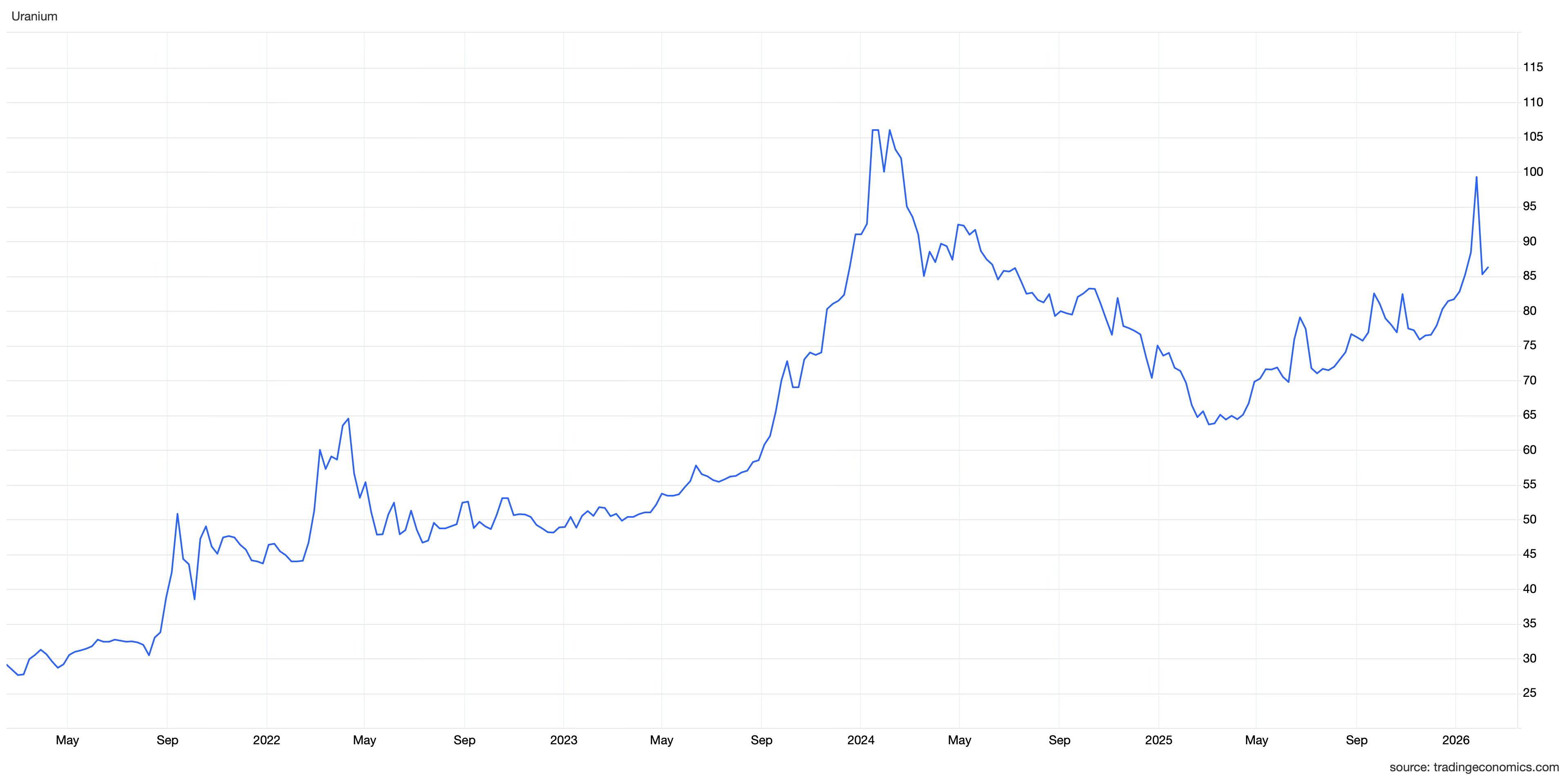
On the supply side, uranium markets are tightening. Kazatomprom, the world’s largest uranium producer, cut its 2025 and 2026 production guidance by over 20 million pounds from prior targets. US in-situ recovery mine restarts have ramped more slowly than initially planned. Secondary uranium supply from commercial inventories and down-blended weapons material is diminishing. Goldman Sachs forecasts uranium spot prices could reach $91 per pound by the end of 2026, representing approximately 20% upside from current levels, and projects a cumulative supply deficit of 13% for 2025-2035, widening to 32% by 2045.
Long-term uranium contract prices rose to $86 per pound in 2025 while spot prices spent most of the year between $63 and $83 per pound. This divergence signals that utilities are willing to pay premiums for guaranteed future supply even as spot markets remained relatively contained. More than 85% of surveyed investors expect uranium prices in the $100 to $120 per pound range in 2026, with some scenarios reaching $135 per pound if supply fails to respond to price signals.
The investment landscape
The small to mid-cap nuclear sector breaks down into three distinct subsectors, each with different risk profiles, timelines, and investment characteristics.
1. Uranium miners and fuel cycle companies
Uranium mining companies extract uranium ore from the ground, typically measured in pounds of U3O8 (yellowcake). The nuclear fuel cycle then moves through conversion (yellowcake to uranium hexafluoride), enrichment (increasing U-235 concentration), and fuel fabrication (creating fuel assemblies for reactors).
A critical bottleneck exists in high-assay low-enriched uranium, or HALEU, production. HALEU contains uranium enriched to between 5% and 20% U-235, compared to 3-5% for conventional light water reactors. Most advanced reactor designs, including small modular reactors and microreactors, require HALEU fuel. Currently, only one US company (more below) holds an NRC license to produce HALEU commercially.
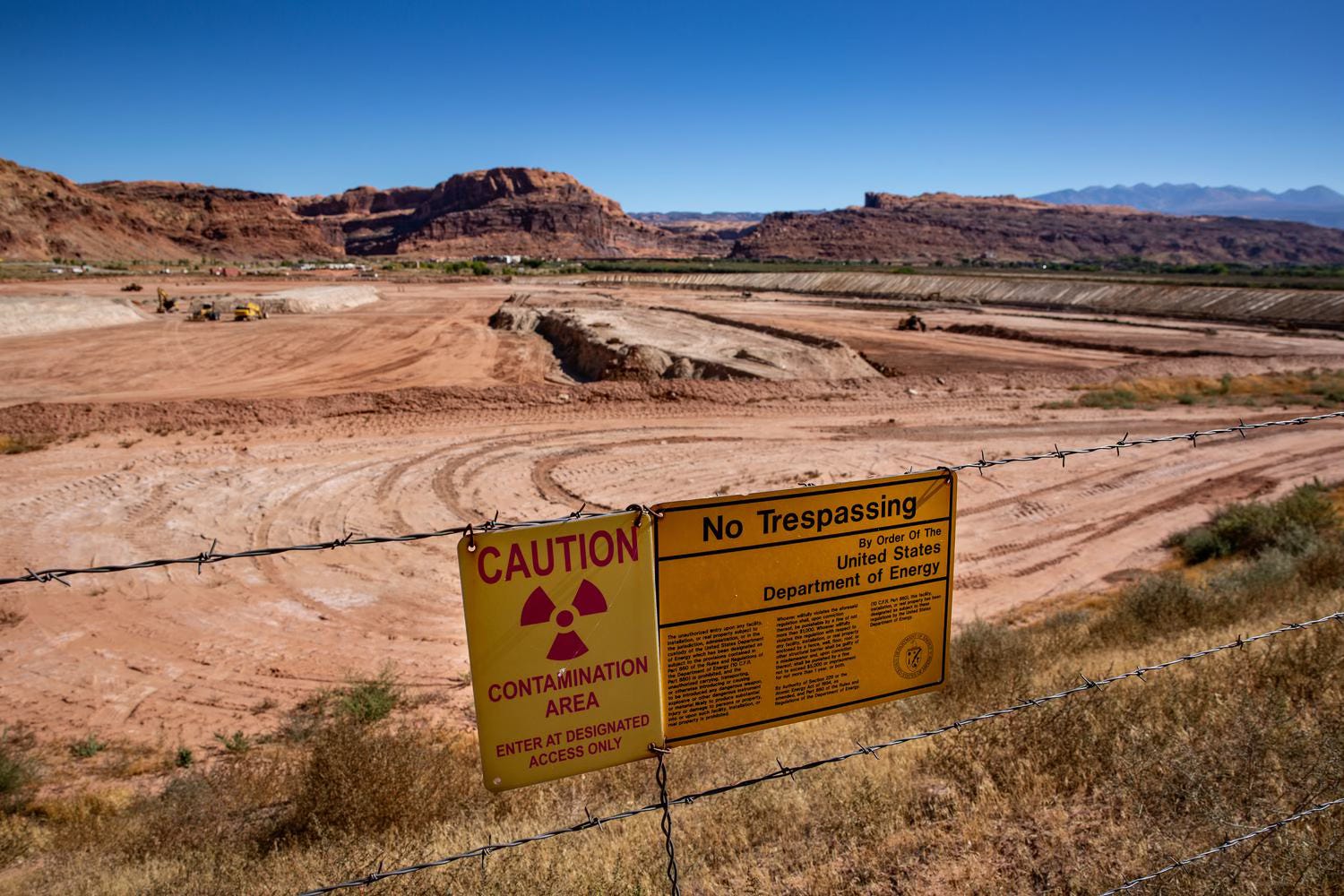
Energy Fuels (UUUU) operates as the largest conventional uranium producer in the United States, running the White Mesa Mill in Utah, the only operating conventional uranium mill in the country. The company produced 11% more finished uranium products in 2025, totaling 1.6 million pounds, and targets 2.0 million pounds in 2026. Energy Fuels also produces rare earth elements, positioning itself across multiple critical minerals.
Ur-Energy (URG) operates the Lost Creek in-situ recovery uranium facility in Wyoming. In-situ recovery, or ISR, dissolves uranium underground and pumps it to the surface, avoiding traditional mining and milling. ISR operations can restart faster than conventional mines but still face multi-year timelines due to wellfield development and regulatory requirements.
Centrus Energy (LEU) operates the only US facility licensed by the Nuclear Regulatory Commission to produce HALEU. The company received a $110 million DOE contract running through June 2026 for HALEU production at its Piketon, Ohio facility. In January 2026, the DOE announced $2.7 billion in contracts to Centrus and other companies for domestic enrichment capacity to offset Russian nuclear fuel supply following sanctions. Centrus represents a “fuel cycle infrastructure” play rather than pure uranium mining.
The uranium mining sector faces long lead times for new production. Mine restarts require years, not months, due to skilled labor shortages, regulatory approvals, and limited processing infrastructure. This structural reality means that even sustained high uranium prices may not resolve supply deficits within typical investment horizons. Developers with permitted assets and existing toll-milling agreements have significant advantages over companies with resources still in exploration or permitting phases.
2. Small modular reactors and advanced reactor developers
Small modular reactors (SMRs) are nuclear reactors with power outputs typically under 300 megawatts, designed to be factory-built and transported to sites rather than constructed on-site like traditional reactors. The value proposition centers on faster deployment timelines (3-5 years versus 10-15 years for large reactors), lower upfront capital costs, and the ability to co-locate with industrial loads, bypassing grid transmission constraints.
The DOE’s Reactor Pilot Program selected 11 companies in June 2025 to work toward achieving criticality by July 4, 2026. This program uses DOE authorization under the Atomic Energy Act rather than NRC licensing, creating a faster pathway to demonstrate reactor concepts. Companies selected include Oklo (two projects), Terrestrial Energy, Aalo Atomics, Antares Nuclear, Atomic Alchemy, Deep Fission, Last Energy, Natura Resources, Radiant Industries, and Valar Atomics. DOE Secretary Chris Wright acknowledged that only one or two reactors may meet the July 4, 2026 deadline, but others are progressing close behind.
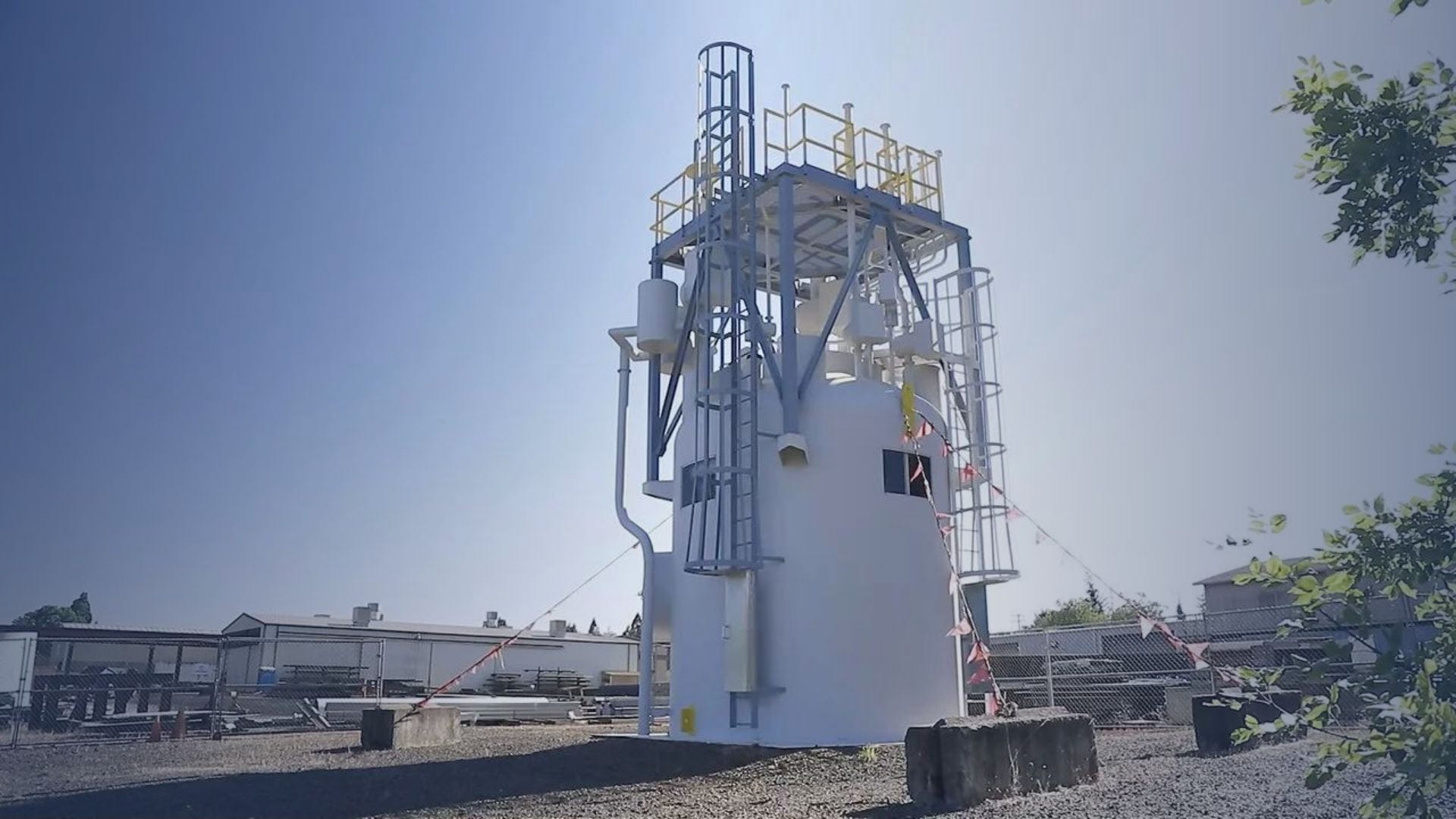
Oklo (OKLO) is developing the Aurora powerhouse, a liquid metal-cooled fast reactor initially designed at 1.5 megawatts but recently upsized to 75 megawatts to meet data center demand. The company operates under a “power-as-a-service” model where Oklo owns and operates reactors, selling electricity under long-term contracts rather than selling reactor units. Oklo was selected for two projects in the DOE Reactor Pilot Program and broke ground at Idaho National Laboratory in August 2025. The company signed agreements with the Department of Defense for potential deployment at military installations and announced partnerships with Meta for up to 750 megawatts of capacity.
NuScale Power (SMR) received the first NRC design certification for a small modular reactor in 2023. Each NuScale module produces 77 megawatts, and multiple modules can be deployed at a single site. The company generates revenue as a subcontractor to Fluor on a planned 462-megawatt plant for Romania’s RoPower, currently in front-end engineering and design phase. NuScale signed an agreement with the Tennessee Valley Authority to deploy up to six gigawatts of capacity across seven states, with plants expected online by 2032. The company remains pre-revenue from commercial operations despite holding NRC certification.
Terrestrial Energy (IMSR) went public through a SPAC merger in October 2025. The company develops a 390-megawatt small modular reactor using integral molten salt reactor technology, a Generation IV design that delivers high capital efficiency using standard nuclear fuel. The stock dropped 68% from its $19.10 debut price to $6.11 by December 31, 2025, but rallied 50% in the first three trading days of January 2026 following announcement of a DOE Other Transaction Authority agreement. Terrestrial Energy is part of the DOE Reactor Pilot Program under Project Tetra.
The SMR sector carries substantial execution risk. These companies are pre-revenue or generate minimal revenue from engineering services rather than electricity sales. Commercial deployment timelines extend into the 2030s for most designs. Capital requirements remain high as companies burn cash through development and regulatory phases. The Carbon Free Power Project, announced in 2015 and expected to be the first US commercial SMR deployment, received NRC certification in 2023 but was canceled the same year after projected costs rose from roughly $60 to $90 per megawatt-hour and participating customers withdrew.
Success in the DOE Reactor Pilot Program, particularly achieving criticality by mid-2026, would provide significant validation for advanced reactor concepts. Failure or substantial delays would raise questions about technical feasibility and commercial timelines across the sector.
3. Equipment, infrastructure, and nuclear operators
Companies providing equipment, components, fuel manufacturing, and operational services benefit regardless of which specific reactor designs achieve commercial success. This subsector includes established industrials with diversified revenue streams rather than pure-play nuclear startups.
BWX Technologies (BWXT) manufactures nuclear components, operates naval nuclear reactor programs, and provides nuclear fuel. The company secured a $1.5 billion contract from the National Nuclear Security Administration in mid-2025 to establish domestic uranium enrichment capability for defense purposes. BWXT collaborates with Kairos Power on commercial TRISO fuel manufacturing. TRISO (tristructural isotropic) fuel consists of uranium fuel kernels surrounded by multiple protective layers, designed to withstand extreme temperatures and contain radioactive materials. The company represents a “picks and shovels” approach to nuclear investment, positioned to supply multiple reactor developers and existing fleet operators.
Fluor (FLR) provides engineering, procurement, and construction services across multiple energy sectors, including nuclear. The company serves as the primary contractor for NuScale Power’s projects and brings decades of experience in large-scale industrial construction. Fluor’s nuclear exposure exists within a much larger diversified business, making it less of a pure-play but providing downside protection through other revenue streams.
Talen Energy (TLN) owns and operates power generation assets including nuclear, fossil fuel, and renewable facilities. The company secured a significant agreement with Amazon in June 2025 to provide 1.92 gigawatts of carbon-free nuclear power through 2042 from the Susquehanna nuclear plant in Pennsylvania. This deal demonstrates the willingness of hyperscalers to lock in long-term capacity at existing nuclear facilities. Talen is expected to benefit substantially from data centers’ demand for reliable, clean energy, with analysts projecting revenue growth exceeding 67% and earnings growth over 100% for 2026.
This subsector offers more immediate revenue visibility compared to pre-revenue SMR developers, though growth rates may be lower and market capitalizations typically larger (in fact, of the list above, only FLR is a mid-cap stock). The trade-off between established cash flows and speculative upside defines the risk-return profile across these three nuclear subsectors.
What I found interesting
Filtering through US-listed nuclear stocks for companies with market capitalizations between $300 million and $10 billion, the list was short. Across uranium miners, fuel cycle companies, SMR developers, and equipment providers, roughly 15 to 20 companies meet these criteria. The fastest-growing areas, particularly HALEU production and advanced reactor development, have almost no mid-cap pure-plays beyond Centrus Energy. Most exposure sits either in large-cap companies like Constellation Energy and Cameco or in micro-cap companies with liquidity constraints and higher volatility.
Like mentioned earlier, only LEU holds an NRC license to produce HALEU commercially in the United States, creating a structural monopoly for the next three to five years until competitors like Urenco and Orano build domestic capacity. Only two publicly traded companies, Oklo and Terrestrial Energy, participate in the DOE Reactor Pilot Program targeting July 4, 2026 criticality. The uranium mining sector has more options, but companies with permitted assets, existing operations, and near-term production capacity number fewer than ten in the small to mid-cap range.
As expected, the regulatory complexity in nuclear is high. NRC licensing timelines stretch years, safety reviews involve multiple agencies, and public opposition can derail projects regardless of technical merit. The DOE Reactor Pilot Program attempts to bypass some of this complexity by using DOE authorization for test reactors, but commercial deployment will still require NRC licensing. The Carbon Free Power Project’s cancellation in 2023, the same year it received NRC certification, demonstrates that regulatory approval alone doesn’t guarantee commercial success. Cost overruns, extended timelines, and customer withdrawals can kill projects even after clearing regulatory hurdles.
But the supply and demand fundamentals appear clearer than in many other sectors. Uranium demand is directly tied to reactor requirements, which utilities plan years in advance with high visibility. Mine supply faces structural constraints that price signals alone cannot quickly resolve. Geopolitical factors, including Russian sanctions and Western fuel cycle re-shoring, add a national security dimension that brings government support and guaranteed off-take regardless of spot prices. The Federal Energy Regulatory Commission projects US data center electricity demand will grow from 19 gigawatts to 35 gigawatts by 2030, and nuclear provides the only carbon-free base-load option with sufficient capacity factor to meet 24/7 requirements.
If nuclear fundamentals continue improving through reactor restarts, DOE program milestones, and utility contracting, the limited universe of mid-cap nuclear pure-plays becomes worth understanding in detail.
Disclaimer
This newsletter is for educational and informational purposes only. Nothing I write constitutes financial advice, investment recommendations, or a solicitation to buy or sell any securities. You should not make investment decisions based solely on my analysis. Always do your own due diligence, consult with qualified financial advisors, and consider your individual circumstances before making any investment. All analysis and opinions are my own and can be wrong. Markets are uncertain, and even well-researched ideas can lose money. I am not a licensed financial advisor and accept no liability for any losses resulting from the use of information in this newsletter.
If this piece helped you, like it, share it, or repost it on Substack, it really helps my work reach more readers like you, and consider subscribing to receive new posts directly to your inbox!